Here you can find selected writings from books to peer-reviewed journal articles.
Designing a Feel for the Game: A Guide to Making Play Meaningful
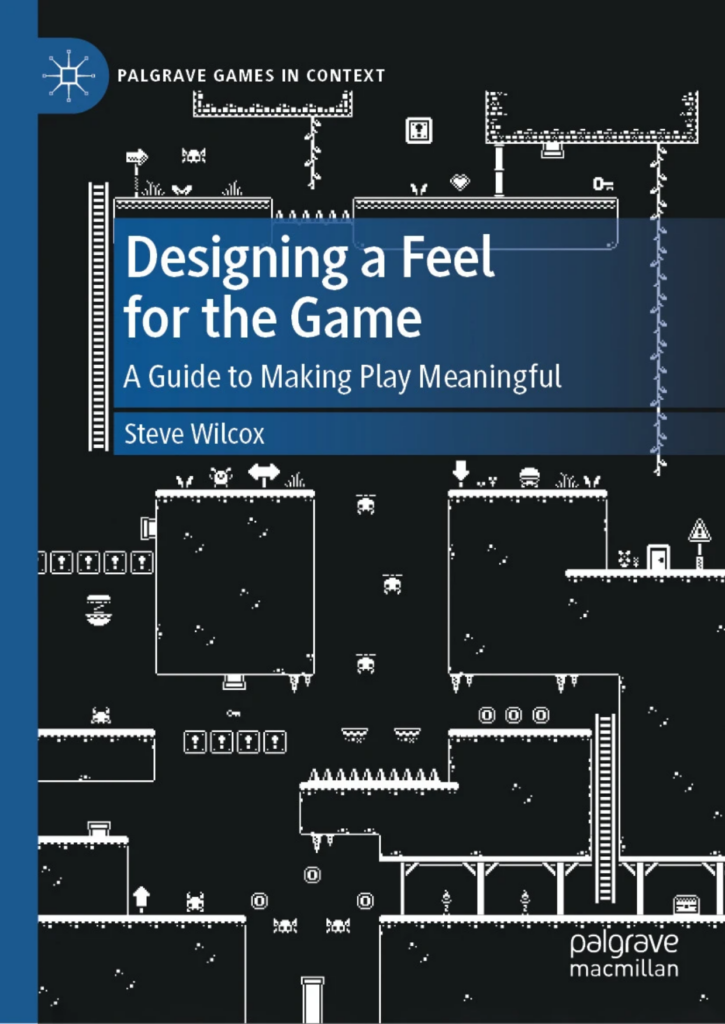
Drawing on over a decade of teaching critical game design, this book translates the social and cognitive science of meaning-making into applied lessons and concepts for designing a feel for your own games. Across eight chapters and a range of topics—including embodied cognition, anthropology, social psychology, affective science, persuasive design, and applied ethics—readers will learn that the mechanisms we already rely on to make sense of and give meaning to the world around us are the very tools we need to make games that feel meaningful and memorable to play.
- Foregrounds the science of sensemaking, helping designers purposefully create games that feel meaningful to players.
- Provides design exercises for use in classroom teaching and/or the development of individual designers’ practices.
Features practical lessons illustrated with various examples from digital, analog, and live action games. Chapters include applied activities developed and refined over a decade of teaching, including individual/group exercises and major design challenge.
Journal Articles
Hello, Worlds: A Ludic Theory of Cognition.
Games and Culture, Volume 21, Issue 5, December 112, 2024.
Games and Culture, Volume 21, Issue 5, December 112, 2024.
Abstract
This article lays the foundation for a ludic theory of cognition. At the core of this approach are two theories of mind and world brought into dialogue with one another: enactive cognition and ludic sociology. Combining these two approaches results in a theory of cognition in which social agents and game players alike rely on cognitive play to enact and inhabit worlds of meaning and significance. In the first section of the article, I draw out the relationship between enactive cognition and cultural theorist Pierre Bourdieu’s ludic sociology, consolidating them into a ludic theory of cognition. In the second section, I examine how the ludic nature of cognition facilitates and inhibits understanding between agents and players, such that cognitive play itself is seen as the means by which we understand ourselves, each other, and the worlds around us.
Games, Language, and Persuasion.
Routledge Handbook of Language and Persuasion. 2023.
Routledge Handbook of Language and Persuasion. 2023.
Abstract
Games have a complex and nuanced relationship with language and persuasion. While working with language can be viewed as a form of play, play can be viewed as discursive, rhetorical, and cultural work. This chapter describes the work that goes into playing games as producing situations in which language and discourse have meaning, situations shaped by various constraints, including the rules of the game. Such constraints contribute to the rhetorical affordances that games possess, including their capacity to foster identification, generate rhetorical situations, persuade through processes and procedures, and to provide players with the language, skills, and knowledge needed to participate in various ludic and discursive communities. In this way, games put language into play, demonstrating both the potential to inform, educate, and empower, but also to coerce, deceive, and manipulate. At the same time, by their procedural nature, games can provide players with the very literacies needed to examine and critique various social and cultural systems, including how those systems afford and constrain language and discourse.
Praxis Games: A Design Philosophy for Mobilizing Knowledge Through Play
American Journal of Play. Spring 2019.
American Journal of Play. Spring 2019.
Abstract
Game design offers a unique but often misunderstood pedagogical opportunity. The author draws on learning theory, feminist epistemology, and game studies to analyze a novel genre of games capable of realizing this opportunity by mobilizing knowledge through play—praxis games—founded on the concept of situated praxis. Situated praxis encourages the design and development of games that guide players to discover knowledge inside a range of communities, domains, and experiences. To demonstrate the applicability of such design, the author discusses his experience with games related to healthcare.
An Ethical Approach to Temporality in Games.
Journal of Gaming & Virtual Worlds, Volume 10, Number 2, 1 June 2018, pp. 115-133(19)
Journal of Gaming & Virtual Worlds, Volume 10, Number 2, 1 June 2018, pp. 115-133(19)
Abstract
Time is a much-explored topic in game studies, as are questions of historical accuracy and ethics. However, an ethics of time in games remains relatively unexplored. This article takes an ethical approach to theorizing game time, drawing on French philosopher Michel Serres’s distinction between linear and topological time. Serres argues that conceiving of time linearly commits us to the belief that progress itself is a deterministic and oftentimes violent series of upheavals. Contemporary videogames that play with time seem to exemplify this. Games like Braid, Assassins Creed, and Prince of Persia: Sands of Time have players manipulate time for the explicit purpose of reproducing a singular narrative, compelling players to synchronize their decisions with a violent, linear series of events. In this article such games are contrasted with more temporally topological titles such as Her Story, The Legend of Zelda: Majora’s Mask, and Life is Strange which deconstruct linearity and demonstrate the ethical affordances of non-linear game temporalities.
On the Publishing Methods of Our Time: Mobilizing Knowledge in Game Studies.
Scholarly and Research Communication Journal. October 2015.
Scholarly and Research Communication Journal. October 2015.
Abstract
There is a considerable amount of academic and non-academic interest in the production and reception of video games. At the same time game scholars encounter questions such as, “are video game academics irrelevant?” In this article I connect questions of relevancy in game studies with the need to develop forms of publishing capable of asserting that relevancy more broadly. As the co-founder and editor-in-chief of First Person Scholar (FPS), a middle-state publication based in the Games Institute at the University of Waterloo, I detail how FPS has attempted to reach beyond the traditional scope of game studies to engage a wider audience and assert a new degree of relevancy for the game scholar.